At Secure Carolinas this year, I kept coming back to something fairly simple: AI makes a lot of things faster. Most AI conversations start with capability, especially what these tools can do better or with less hands-on work. Fair enough. In day-to-day work, though, one of the first changes is often simpler. Something that took half a day can suddenly take twenty minutes.
That is useful in very ordinary ways. An idea can get tested before it goes cold. Research that used to mean hunting through six tabs or a shared drive gets you to a starting point much sooner. What interests me more is what happens around that faster work.
Some of the more important AI adoption challenges start showing up there. More ideas make it far enough to need a decision, and information can move before someone has fully questioned it. Attackers get some of the same advantages too. Those effects are different enough that it is worth looking at them separately.
A Faster “No” Still Counts
One of the easiest AI wins to overlook is deciding sooner that an idea is not worth more time. A rough concept that once needed days of research or planning can sometimes get far enough in an afternoon to show whether there is really anything there. If the answer is no by Tuesday, the team does not spend the rest of the week building a plan around it. I would rather see AI save that time than treat every experiment as something that needs to become a project.
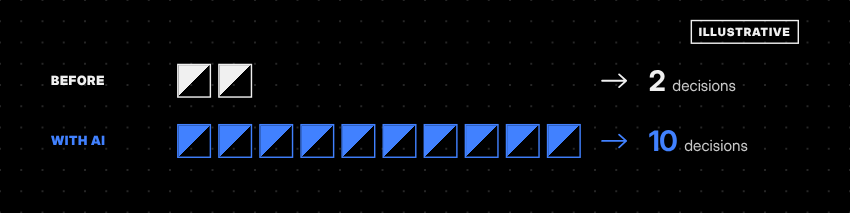
The catch is that cheaper experiments create more things to judge. If a team can test ten directions where it once had time for two, the work may get easier to produce while the decisions start piling up. Someone still has to know which ideas are worth another round and which ones are done.
Clean Answers Can Hide a Mess
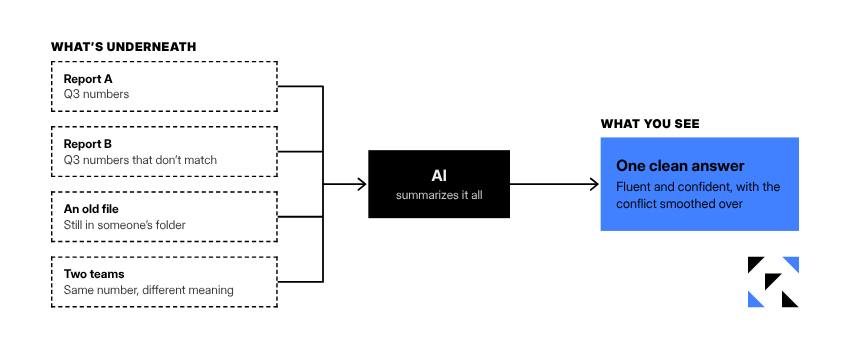
Most companies already have some information messiness if you look closely enough. Two reports disagree, or somebody is working from an old file. Sometimes two teams are using the same number to mean slightly different things. People usually learn where those rough edges are because they run into them.
AI can make that mess less visible. NIST explains that generative AI models produce output through statistical prediction, which means a response is not independently verified just because it sounds polished or confident. If two reports disagree while I am staring at them, I know there is something to sort out. If those same reports disappear behind one neat summary, I may never see the disagreement at all. Someone may spend much less time finding the answer, which is useful, but more judgment goes into deciding how much confidence to put in it.
Attackers Get More Chances
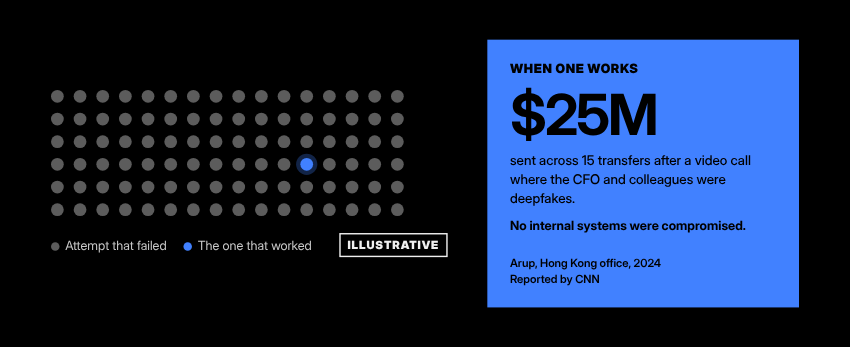
A phishing attempt can fail for all kinds of ordinary reasons. Maybe the message sounds wrong. Maybe the person on the other end simply double-checks it. The FBI has warned that generative AI reduces the time and effort criminals need to create convincing messages, clone voices, and fake video calls. That makes another try easier, and most attempts can fail if one eventually works.
We have already seen what that can look like. An employee at engineering firm Arup’s Hong Kong office sent roughly $25 million across 15 transfers after joining a video call where the CFO and other supposed colleagues were deepfakes. Arup said its internal systems were not compromised. The deception worked on the person and the process around them.
That last part matters to me. The UK’s National Cyber Security Centre expects AI to make cyberattacks more frequent and intense through 2027, largely by improving methods attackers already use. It is also watching the time between a vulnerability becoming public and attackers exploiting it continue to shrink. Security teams have always worked against the clock to some degree. AI gives the other side more ways to shorten it.
Some Delays Are Doing Real Work
Businesses spend a lot of time trying to remove delays, usually for good reason. Nobody misses waiting three days for something that should take ten minutes. But not every pause is wasted time. Sometimes that is where someone notices the numbers look strange or decides something needs another look before it goes any further. AI can remove the pointless waiting and compress those useful pauses at the same time.
That is why I would be careful about treating AI adoption challenges as mostly technology problems. IT may own the platform, but the harder calls tend to sit around it. How much authority should the system have? Where does someone still need to review the result? Some decisions probably should not move at machine speed at all.
Start With One Real Use Case
You do not need to map every possible AI use case across the business to learn something useful. Pick one people are already working with, or one close enough to deployment that the questions are no longer hypothetical. Where does it actually save time? Who makes the next decision? What information are they trusting, and where would a mistake go if nobody caught it?
The awkward answers are usually the useful ones. Maybe an approval step belongs to three people and, in practice, nobody. Maybe everyone assumes a set of documents is current because nobody has had a reason to question it yet. The technology may even work fine while the process around it made more sense when everything moved a little slower.
Digital Transformation Goes Beyond AI
For ITonDemand, that is where AI fits into the larger digital transformation conversation. New technology can change the pace of work pretty quickly, but everything around it still has to keep up. We help businesses connect those technology changes to the way their systems and processes already work, so a new tool has somewhere sensible to fit once people start using it.